Museum of Fine Arts Amon Carter Museum of American Art
 | |
 | |
| Established | January 1961[1] |
|---|---|
| Location | 3501 Camp Bowie Boulevard Fort Worth, Texas 76107-2695 (United States) |
| Executive managing director | Dr. Andrew J. Walker |
| Architect | Philip Johnson |
| Website | Amon Carter Museum of American Art |
The Amon Carter Museum of American Fine art (ACMAA) is located in Fort Worth, Texas, in the city's cultural commune. The museum's permanent drove features paintings, photography, sculpture, and works on newspaper by leading artists working in the United States and its North American territories in the nineteenth and twentieth centuries. The greatest concentration of works falls into the period from the 1820s through the 1940s. Photographs, prints, and other works on newspaper produced up to the nowadays day are also an area of forcefulness in the museum's holdings.
The drove is particularly focused on portrayals of the Onetime W by Frederic Remington and Charles M. Russell, artworks depicting nineteenth-century exploration and settlement of the North American continent, and masterworks that are emblematic of major turning points in American art history. The "full spectrum" of American photography is documented by 45,000 exhibition-quality prints, dating from the primeval years of the medium to the nowadays.[two] A rotating selection of works from the permanent collection is on view year-round during regular museum hours, and several thousand of these works can be studied online using the Collection tab on the ACMAA's official website. Museum access for all exhibits, including special exhibits, is gratuitous.
The Amon Carter Museum of American Art opened in 1961 as the Amon Carter Museum of Western Art. The museum'south original collection of more than than 300 works of art by Frederic Remington and Charles M. Russell was assembled past Fort Worth newspaper publisher and philanthropist Amon One thousand. Carter, Sr. (1879–1955).[three] Carter spent the concluding 10 years of his life laying the legal, financial, and philosophical groundwork for the museum's creation.[iv]
Collection [edit]
Western fine art by Frederic Remington and Charles M. Russell [edit]

Frederic Remington (1861–1909), An Indian Trapper, 1889

Portrait photograph of Charles Marion Russell, ca. 1900
Over 400 works of art by Frederic Remington (1861–1909) and Charles K. Russell (1864–1926) form the ACMAA's cadre collection of art of the Former West. These holdings include drawings, illustrated letters, prints, oil paintings, sculptures, and watercolors produced by Remington and Russell during their lifetimes. More than sixty of the works past Remington and more than than 250 of the works by Russell were purchased past the museum's namesake, Amon G. Carter, Sr., over a twenty-twelvemonth span beginning in 1935.[three] Additions to Amon Carter'due south original holdings by museum curators take resulted in a collection that contains multiple examples of Remington's and Russell's best work at every stage of their respective careers.[5]
Frederic Remington and Charles G. Russell were America'south best known and nearly influential western illustrators. Working from his New York studio except when traveling, Remington produced colorful and masculine images of life in the Old West that shaped public perceptions of the American frontier experience for an eastern audience eager for data.[6] Montana resident Charles Russell, with his cowboy dress, laconic manner, and storytelling prowess, epitomized, in the early on twentieth-century, the epitome of the Cowboy Artist in the eyes of the eastern press.[seven]

Remington and Russell Gallery in the Amon Carter Museum of American Art, 2019
Though neither artist had lived on the frontier at the top of America'south w expansion, their drawings, paintings, and sculptures were infused with the action and convincing realism of straight observation. Russell moved to Montana Territory in 1880, nine years before statehood, and had worked as a cowboy for more than a decade before beginning his career equally a professional person artist.[8] Remington toured Montana in 1881, later owned a sheep ranch in Kansas, and had traversed Arizona Territory in 1886 every bit an illustrator for Harper's Weekly.[9] These and other experiences enabled both artists to convincingly portray a vast diversity of Onetime West subject matter drawing on real world experiences, historical evidence, and their artistic imaginations.
Noteworthy artworks in the ACMAA collection by Remington and Russell include: 1) Frederic Remington, A Dash for the Timber (1889; see gallery below) -- a piece of work that established Remington as a serious painter when information technology was exhibited at the National Academy of Pattern in 1889.[10] ii) Frederic Remington, The Broncho Buster (1895) -- Remington'southward first try to model in statuary and the work that started him on a long secondary career as a sculptor. 3) Frederic Remington, The Fall of the Cowboy (1895) -- an evocation of the fading of the mythic cowboy of legend, anticipating Owen Wister's historic novel, The Virginian (1902).[11] 4) Charles M. Russell, Medicine Human being (1908) -- a detailed portrait of a Blackfeet shaman, reflecting Russell's empathy with Native American civilisation.[12] five) Charles M. Russell, Meat for Wild Men (1924) -- a statuary sculpture that evokes the "grand turmoil" resulting equally a band of mounted hunters descends upon a herd of grazing buffalo.[13]
Expeditionary art and depictions of Native American life [edit]

John Mix Stanley (1814–1872), Oregon City on the Willamette River, ca. 1852
The ACMAA houses a broad option of maps and artworks past European and American documentary artists who, in the nineteenth and twentieth centuries, traveled the North American continent in search of new sights and discoveries. Some of these artists worked independently, focusing on subjects or areas of the country of their ain choosing. Others served as documentarians on expeditions of continental discovery sent out by the U. S. government or by European sponsors. In these roles, artists were uniquely positioned to record the topography, fauna and found life, and diverse Indian culture of America and its frontiers. Finding and collecting drawings, oil paintings, watercolors, and published lithographs by these European and American documentary artists was 1 of the museum'southward primeval goals.[14] Documentary artists represented in the collection include John James Audubon (1785–1851), Karl Bodmer (1809–1893), George Catlin (1796–1872), Charles Deas (1818–1867), Seth Eastman (1808–1875), Edward Everett (1818–1903), Francis Blackwell Mayer (1827–1899), Alfred Jacob Miller (1810–1874), Peter Moran (1841–1914), Thomas Moran (1837–1926), Peter Rindisbacher (1806–1834), John Mix Stanley (1814–1872), William Guy Wall (1792–after 1864), Carl Wimar (1828–1862), and others. Run across Works on paper (below) for more than information on American expeditionary art.
Landscape paintings and coastal scenes [edit]
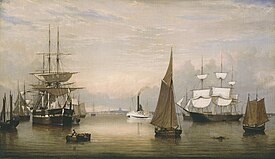
Fitz Henry Lane (1804–1865), Boston Harbor, 1856
The Hudson River School, one of the critical movements in nineteenth-century American mural painting, is an important focus of the ACMAA collection. Ii major oils by Thomas Cole (1801–1848) and one past Cole's protégé Frederic Edwin Church (1826–1900) anchor the museum'due south holdings of signature Hudson River School paintings. The Narrows from Staten Island (1866–68), a panoramic delineation of Staten Isle and New York Harbor by Jasper Francis Cropsey (1823–1900), is a notable case of the Hudson River School'southward preoccupation with scenery along the Hudson River Valley and surrounding surface area (see picture gallery below).
The Pre-Raphaelite movement, a British movement that was briefly influential among some artists of the Hudson River School in the mid-nineteenth century, is exemplified in Woodland Glade (1860) by William Trost Richards (1833–1905) and Hudson River, Above Catskill (1865) by Charles Herbert Moore (1840–1930). The Moore painting depicts an identifiable portion of the Hudson River adjacent to the home of Thomas Cole, making it likely that the painting was intended as a tribute to Cole.
Hudson River Schoolhouse paintings that reverberate the influence of Luminism are too found in the ACMAA drove. These include works past Sanford Robinson Gifford (1823–1880), Martin Johnson Heade (1819–1904), John Frederick Kensett (1816–1872), and Fitz Henry Lane (1804–1865). Given its "night, brooding mystery," the painting by Heade, Thunder Tempest on Narragansett Bay (1868), is considered by many observers to be the artist's masterpiece.[15]
Other Hudson River School artists represented in the collection past major oil paintings are Robert Seldon Duncanson (1821–1872), David Johnson (1827–1908), and Worthington Whittredge (1820–1910). William Stanley Haseltine (1835–1900) is represented past a preliminary written report of rocky coastline along Narragansett Bay, Rhode Island.
The influence of the Hudson River Schoolhouse and Luminism was focused on a western United States location about 1870 when Albert Bierstadt (1830–1902) produced Sunrise, Yosemite Valley. This grandiose example of the creative person'due south piece of work was completed later Bierstadt's tertiary trip to the American westward.[sixteen] It was added to the ACMAA drove in 1966. Another Hudson River School painter who headed due west was Thomas Moran (1837–1926). Moran, famous for his paintings of the Yellowstone region of Wyoming, is represented in the ACMAA drove by his 1874 oil Cliffs of Green River (see picture gallery below).
Figure paintings, portraits, and images of everyday life [edit]
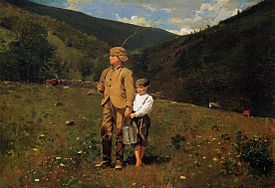
Winslow Homer (1836–1910), Crossing the Pasture, 1871–72
Nineteenth-century figure paintings, portraits, and genre pictures (portrayals of everyday life) represent an important chapter in the history of American art development, and several examples of these types of paintings are found in the ACMAA collection. Swimming (1885) by Thomas Eakins (1844–1916) is one of the best-known realist figure paintings in the history of American art.[17] A summation of Eakins' painting technique and conventionalities system, Pond was acquired for the ACMAA collection in 1990.[xviii] Crossing the Pasture (1871–72) by Winslow Homer (acquired 1976) combines the artist's skills as a figure painter with his gift for storytelling to create a charming paradigm of rural New York life.
Indian Group (1845) by Charles Deas (1818–1867) explores the physical appearance of Deas' Native American subjects and the perils associated with their nomadic lifestyle (run across picture gallery below). The Potter (1889) by George de Wood Brush (1855–1941) is another case in the ACMAA collection of an artist'south exacting and nuanced method of depicting an ethnic American sitter. Attention Visitor! (1878) by William Thou. Harnett (1848–1892) is the only known figural limerick past this American main of trompe-50'œil ("fool the eye") painting.[19]
A major historical genre painting past William T. Ranney (1813–1857) is in the ACMAA drove. Ranney'due south Marion Crossing the Pedee (1850) exhibits the artist's great skill as a figure painter and use of that skill to entertain and educate his nineteenth-century audience. Notable genre paintings by Conrad Wise Chapman (1842–1910), Francis William Edmonds (1806–1863), Thomas Hovenden (1840–1895), and Eastman Johnson (1824–1906) are also housed in the ACMAA collection.
Portraitist John Vocalizer Sargent (1856–1925) is represented in the museum's collection by formal portraits of two American subjects, Alice Vanderbilt Shepard (1888), and Edwin Berth (1890; see pic gallery below).
Nevertheless-life paintings and sculpture [edit]

William J. McCloskey (1859–1941), Wrapped Oranges, 1889

Henry Kirke Chocolate-brown (1814–1886), The Choosing of the Arrow, modeled 1848, cast 1849
Trompe-fifty'œil ("fool the eye") paintings and classic still-life paintings brand up a prominent component of the ACMAA collection. Ease (1887) by William G. Harnett (1848–1892) is a large and eloquent example of the trompe-fifty'œil genre and i that handsomely demonstrates the allure of Harnett's trompe-l'œil illusions for his nineteenth-century patrons.[twenty] John Frederick Peto (1854–1907), a William Harnett contemporary who worked in relative obscurity, is represented in the collection by ii highly achieved trompe-l'œil compositions, Lamps of Other Days (1888) and A Closet Door (1904-06). Other trompe-fifty'œil paintings in the ACMAA collection were created by De Scott Evans (1847–1898) and John Haberle (1853–1933).
America'south first recognized still-life painter, Raphaelle Peale (1774–1825), is represented in the ACMAA collection by an 1813 composition Peaches and Grapes in a Chinese Export Basket. Other classic American notwithstanding lifes featuring fruit or flowers include Wrapped Oranges (1889) past William J. McCloskey (1859–1941) and Abundance (after 1848) past Severin Roesen (1815–after 1872).
The ACMAA sculpture collection provides historical context for the museum's deep holdings of statuary sculpture by Frederic Remington and Charles G. Russell, likewise as acknowledging the importance of sculpture in the wider history of American art. As such, the collection contains works created past leading individuals in both the nineteenth and twentieth centuries. The Choosing of the Arrow (1849) past Henry Kirke Dark-brown (1814–1886) is one of the primeval bronzes cast in America. Slightly later statuary sculptures, The Indian Hunter (1857–59) and The Freedman (1863), both past John Quincy Adams Ward (1830–1910), are too in the collection. Bust of a Greek Slave (after 1846) past Hiram Powers (1805–1873) is an example of an American neoclassical piece of work carved in marble.
Ii American sculptors who enjoyed great success during their lifetimes, Frederick MacMonnies (1863–1937) and Augustus Saint-Gaudens (1848–1907), are represented in the ACMAA collection past cast statuary works created in the late nineteenth century. Alexander Phimister Proctor (1860–1950) and Anna Hyatt Huntington (1876–1973) are represented by bronzes created in the late nineteenth and early twentieth centuries respectively. A bronze sculpture past Solon Borglum (1868–1922), who, like Remington and Russell, specialized in depictions of Old West subjects, and a 2-piece bronze past Paul Manship (1885–1966), Indian Hunter and Pronghorn Antelope (1914), are in the collection every bit well.
The experimentation of early twentieth-century artists with nature-based brainchild and direct carving techniques from natural materials is seen in works by John Flannagan (1895–1942), Robert Laurent (1890–1970), and Elie Nadelman (1882–1946). Signature works past Alexander Calder (1898–1976) and Louise Nevelson (1899–1988) are among the mid-twentieth century sculptural pieces in the collection. Nevelson's Lunar Landscape is a large, painted-wood structure that dates to 1959-60 (see picture gallery below).
American Impressionist paintings and 20th-century modernist works [edit]

Childe Hassam (1859–1935), Flags on the Waldorf, 1916

Charles Demuth (1883–1935), Chimney and Water Tower, 1931
The ACMAA collection contains several examples of American Impressionism.
Idle Hours (almost 1894) by William Merritt Hunt (1849–1916) anchors the ACMAA holdings of American Impressionist paintings. Chase's student and protégé Julian Onderdonk (1882–1922) is represented past a Texas scene, A Cloudy Day, Bluebonnets virtually San Antonio, Texas (1918). Flags on the Waldorf (1916) is a signature New York work by Childe Hassam (1859–1935). Other well-known American Impressionist painters who have pieces in the collection are Mary Cassatt (1844–1926), Willard Metcalf (1858–1925), and Dennis Miller Bunker (1861–1890; see picture gallery beneath).
New York photographer Alfred Stieglitz (1864–1946) befriended and championed several of the most visionary modernistic painters to emerge in early twentieth-century America. Five modern artists who were closely identified with Stieglitz'south circumvolve are represented in the ACMAA collection. They are Charles Demuth (1883–1935), Arthur Thou. Pigeon (1880–1946), Marsden Hartley (1877–1943), John Marin (1870–1953), and Georgia O'Keeffe (1887–1986). The collection houses early works past Demuth, Dove, Hartley, and O'Keeffe, produced between 1908 and 1918, and a focused group of after paintings by Dove, Hartley, Marin, and O'Keeffe that capture their response to the lite and color of the New Mexican landscape near Taos. Charles Demuth'southward Chimney and H2o Tower (1931), painted in the creative person'south hometown of Lancaster, Pennsylvania, depicts a local linoleum mill as a grid of austere, monumental forms and passages of steel gray, blueish, and deep crimson.[21] Chimney and Water Tower entered the ACMAA drove in 1995.
Several important paintings by American modernist Stuart Davis (1892–1964) are housed in the Amon Carter Museum of American Art, including an early self-portrait painted in 1912 and a work from his Egg Beater series, Egg Beater No. 2 (1928). American modernists represented in the AMCAA drove too include Josef Albers (1888–1976), Will Barnet (1911–2012), Oscar Bluemner (1867–1938), Morton Schamberg (1881–1918), Ben Shahn (1898–1969), Charles Sheeler (1883–1965), Joseph Stella (1877–1946), and others (run across picture show gallery beneath).
Photography [edit]

Laura Gilpin (1891–1979), The Church building at Picuris Pueblo, New United mexican states, 1963
The Amon Carter Museum of American Fine art is one of the country's major repositories for historical and fine art photographs.[22] The ACMAA has over 350,000 photographic works in its collection, including 45,000 exhibition-quality prints. These holdings span the complete history of photographic processes used in America from daguerreotypes to digital. Photography's central role in documenting American culture and history, and the medium's evolution as a significant and influential art form in the twentieth-century to the present, are the themes around which the ACMAA photography collection is organized.
The personal archives of photographers Carlotta Corpron (1901–1988), Nell Dorr (1893–1988), Laura Gilpin (1891–1979), Eliot Porter (1901–1990), Erwin East. Smith (1886–1947), and Karl Struss (1886–1981) are prominent collection resources.[2] Finding aids and guides for these and other monographic collections are available online nether the Collections/Photographs/Learn More tabs on the ACMAA website.

William Henry Jackson (1843–1942), Cañon of the Rio Las Animas, 1882
The ACMAA photography collection contains early on images of Americans at war, anchored by 55 Mexican–American War (1847–1848) daguerreotypes. The drove houses a copy of Alexander Gardner's two-volume work, Gardner's Photographic Sketch Book of the Civil War and a copy of Photographic Views of Sherman's Campaign (1865) past George Barnard. A group of more than i,400 nineteenth and early twentieth-century portraits of Native Americans that originated with the Bureau of American Ethnology is another of the drove'southward highlights, along with a complete set of Edward Curtis's The Due north American Indian.
The ACMAA's collection of nineteenth-century mural photographs includes images by John K. Hillers (1843–1925), William Henry Jackson (1843–1942), Timothy H. O'Sullivan (1840–1882), Andrew J. Russell (1830–1902), and Carleton E. Watkins (1829–1916). Twentieth-century master images by Ansel Adams (1902–1984) are complemented by after twentieth-century landscapes from the studios of William Clift (born 1944), Frank Gohlke (born 1942), and Mark Klett (born 1952).
Fine fine art photographs by Alfred Stieglitz (1864–1946) are the collection'due south well-nigh significant works from the plough-of-the-twentieth-century Photo-Secession movement, a crusade which Stieglitz led. The work of the Photo-Secessionists and other leading photographers of the period is too documented in complete runs of Photographic camera Notes (published 1897–1903), Photographic camera Work (published 1903–1917), and 291 (published 1915–1916).
Substantive holdings of twentieth-century documentary photographs include works by Berenice Abbott (1898–1991); prints produced over 20-five years in connection with Dorothea Lange'southward The American Country Woman photographic essay; Texas images from the Standard Oil of New Bailiwick of jersey Drove; and project photographs from the 1986 statewide survey Gimmicky Texas: A Photographic Portrait. Additionally, twentieth-century documentary photographs by Russell Lee (1903–1986), Arthur Rothstein (1915–1985), Marion Post Wolcott (1910–1990), and many others are housed in the museum's collection.
Other noun groups of twentieth-century photographs in the ACMAA drove are organized effectually the careers of Robert Adams (built-in 1937), Barbara Crane (born 1928), Frank Gohlke (born 1942), Robert Glenn Ketchum (built-in 1947), Clara Sipprell (1885–1975), Brett Weston (1911–1993), and Edward Weston (1886–1958).
The ACMAA owns a consummate ready of prints from Richard Avedon'due south In the American West series, a projection deputed by the ACMAA in 1979. In recent years the museum has largely focused on acquiring and displaying photographs past contemporary artists including Dawoud Bey (born 1953), Sharon Cadre (born 1965), Katy Grannan (born 1969), Todd Hido (born 1968), Alex Prager (born 1979), Marking Ruwedel (born 1954), and Larry Sultan (1946–2009).
Works on newspaper [edit]

John Mix Stanley (1814–1872), The Young Main Uncas, 1869
Much of America'southward aesthetic, economical, and social history is establish in works on paper, a category that includes drawings, prints, and watercolors.[23] The ACMAA began to actively collect works on paper in 1967.[24] The drove today numbers several k items past noted artists of the nineteenth and twentieth centuries to the present.[25] Drawings and paintings range from preliminary studies to fully realized compositions. Nearly nineteenth-century prints originated as reproductions intended for dissemination to the public and draw subjects relevant to the American feel. Twentieth-century and subsequently prints are fine art prints made past a variety of processes equally a means of artistic self-expression.
Prints that stem from early western surveys conducted by the United states of america State of war Department and the United States Department of the Interior are of import components of the works on paper collection. These prints were typically based on field sketches by artists who accompanied the expeditions. They provide unique views of the western landscape, Indian life, natural history, ancient Spanish civilization, and life in nineteenth-century American frontier communities. The Frémont Expeditions (1842–44), Emory Expedition (1846–47), Abert Trek (1846–47), and Simpson Expedition (1849) are among the sources of western survey prints nerveless by the ACMAA.
The ACMAA's nineteenth-century print drove also includes a copy of the landmark Hudson River Portfolio (1821–25) based on the work of painter William Guy Wall (1792–after 1864) and engraver John Hill (1770–1850); original copper plate etchings of Native Americans every bit depicted in field studies past Karl Bodmer (1809–1893); a complete prepare of planographic prints from George Catlin'due south North American Indian Portfolio (1844); and ornithological prints from John James Audubon's landmark book The Birds of America (published 1827–38).

Henry Roderick Newman (1843–1917), Anemones, 1876
Examples of work in the collection past other noted expeditionary artists include rare nineteenth-century field studies by Edward Everett (1818–1903), Richard H. Kern (1821–1853), John H. B. Latrobe (1803–1891), Alfred Jacob Miller (1810–1874), and Peter Rindisbacher (1806–1834); nineteenth-century views of the American Westward by John Mix Stanley (1814–1872) and Henry Warre (1819–1898); and early views of San Francisco by Thomas A. Ayres (1816–1858). Encounter Expeditionary fine art and depictions of Native American life (above) for more information on American expeditionary art and artists.
Preeminent American artists of the late nineteenth and early twentieth centuries like Winslow Homer (1836–1910), George Inness (1825–1894), John La Farge (1835–1910), and famed expatriates John Singer Sargent (1856–1925) and James Abbott McNeill Whistler (1834–1903) are each represented by high-quality drawings and/or paintings in the ACMAA works on paper drove.[24]
Other artists in the works on paper collection who are associated with major movements in American art include American Pre-Raphaelites Fidelia Bridges (1834–1923), Henry Farrer (1844–1903), John Henry Hill (1839–1922), Henry Roderick Newman (1833–1918), and William Trost Richards (1833–1905); Ashcan School illustrator John Sloan (1871–1951); and leading twentieth-century modernists Charles Demuth (1883–1935), Arthur Pigeon (1880–1946), John Marin (1870–1953), Georgia O'Keeffe (1887–1986), Morton Livingston Schamberg (1881–1918), and Abraham Walkowitz (1878–1965).[26]
A chief set up of over 200 lithographs by American realist painter George Wesley Bellows (1882–1925) is 1 of the highlights of the ACMAA'southward works on paper collection. Leading American printmakers Martin Lewis (1881–1962), Louis Lozowick (1892–1973), and Reginald Marsh (1898–1954) are each represented past multiple examples of their graphic work. Also housed in the collection are early works by Edward Hopper (1882–1967) and a consummate set of prints past modernist Stuart Davis (1892–1964). An early on watercolor by Jacob Lawrence (1917–2000), caused in 1987, marks the ascension of this important artist'south career.
The ACMAA collection houses almost 2,500 art lithographs fabricated at the Tamarind Lithography Workshop in Los Angeles, California between 1960 and 1978. The museum also houses an important collection of drawings, watercolors, and prints by early on Texas artist Bror Utter (1913–1993), including Utter'southward 1957-58 studies of vanishing Fort Worth architecture. Most recently, the ACMAA added two of import series of lithographs to these holdings, ane by Glenn Ligon (born 1960) and another past Sedrick Huckaby (born 1975).
Library and athenaeum [edit]

Amon Carter Museum of American Art Library Reading Room
The ACMAA library is a 150,000 item fine art reference library bachelor for use by museum curators, researchers, and interested members of the public. The library provides access to a fifty,000 book collection, augmented past related collections of microform, periodicals and journals, auction catalogs, and ephemera.[27] The library's holdings are non-circulating and organized around the report of American art, photography, and civilization from Colonial times to the nowadays, with an emphasis on materials that heighten understanding of objects in the museum's permanent art collection and the milieu in which these objects were created.
The ACMAA library'south microform holdings include 14,000 microfilm reels of nineteenth-century newspapers, periodicals, books, and other master cloth. These holdings besides include more than than l,000 microfiches of auction and exhibition catalogues, ephemera, and other textile. Specific microform sets include the Knoedler Library on Microfiche (fine art auction and exhibition catalogs), New York Public Library Artists File, New York Public Library Impress File, and America, 1935–1946 (photographs from the Farm Security Assistants and the Part of War Data in the Prints and Photographs Partition, Library of Congress).[27] The Amon Carter Museum of American Art is the mid-land inquiry affiliate of the Archives of American Art, Smithsonian Institution.[27] In this role, the ACMAA library offers access to 7,500 microfilm reels of unrestricted material from the Athenaeum of American Art representing nigh fifteen-million main, unpublished documents related to American artists, galleries, and collectors.[28]

Alexander Wilson (1766–1813), Blue Jay, Yellow Bird or Goldfinch, Baltimore Bird, American Ornithology - Plate 1, published 1809–14
The library'due south Vertical File/Ephemera drove contains a broad diverseness of loose material and small-scale publications on artists, museums, commercial galleries, and other art organizations. Included in this drove are biographical files, arranged by name, with coverage of near 9,000 artists, photographers, and collectors.[27] These biographical files offering researchers a wealth of newspaper clippings, pocket-sized exhibition catalogs, resumes, journal and periodical articles, reproductions, event invitations and announcements, portfolios, bibliographies, and like material from which to describe.
The ACMAA library houses a number of rare illustrated books. These titles are useful for their textual information and valuable as works of art for their original prints. Among the illustrated books in the library collection are American Ornithology, or, the Natural History of the Birds of the United states of america (Philadelphia: Bradford and Inskeep, 1809–14), the commencement bird volume published in the United States and the beginning outstanding American colour plate book; and The Aboriginal Port-folio (Philadelphia: J.O. Lewis, 1835–36), the start color plate volume published on the Northward American Indian. Other illustrated books owned by the library are highlighted under the Drove tab on the ACMAA website, and many of the illustrations within these books are digitized and searchable.[29]
The museum archives contain private papers and records originating from individuals, usually artists or photographers, that are often integrally connected to the museum's art collection. Amidst these records are the personal archives of photographers Laura Gilpin (1891–1979), Eliot Porter (1901–1990), and Karl Struss (1886–1981).[xxx] The archives also house the business records of the Roman Bronze Works (est. 1897-closed 1988) of Queens, New York, long i of America'due south premier art statuary foundries, and a range of documents related to the ACMAA's institutional history.
In 1996, the ACMAA library partnered with the libraries of the Kimbell Fine art Museum and the Modernistic Fine art Museum of Fort Worth to create the Cultural District Library Consortium (CDLC). The purpose of the consortium was to explore new ways of sharing the resources of the three Fort Worth institutions via online public admission. In 1998, with technical assistance from the library at Texas Christian University, the three museums launched an online CDLC catalog that allows website visitors access to the combined collections of all iii art museum libraries.[31] Today, the CDLC catalog as well gives access to the libraries of the National Cowgirl Museum and Hall of Fame, and the Botanical Enquiry Constitute of Texas (BRIT). To search the ACMAA library holdings, click Search the ACMAA Library Itemize in the External links section (beneath).
Professional person assistance and access to items in the Amon Carter Museum of American Art library is provided in the library reading room during the stated hours of performance. More information is available nether the Library tab on the ACMAA website.
History [edit]

Amon Thousand. Carter, Sr. as a young newspaperman and entrepreneur in Fort Worth, ca. 1910
An admission-free museum of western art was conceived by Amon Chiliad. Carter, Sr. (1879–1955), publisher of the Fort Worth Star-Telegram, a large-circulation, daily newspaper in Fort Worth, Texas. Carter and his wife, Nenetta Burton Carter, took a cardinal step toward the museum's creation in 1945 when the Amon One thousand. Carter Foundation, a Texas non-turn a profit foundation, was formed, and the Carters transferred much of their wealth into information technology for the purpose of providing seed money to support an array of civic causes.[32] At the fourth dimension the foundation was incorporated, Amon Carter had been actively collecting fine art by Frederic Remington and Charles Grand. Russell for a decade.[33]
On Oct 3, 1950, Carter informed the City of Fort Worth of his intention to "erect and equip" a museum and present it to the metropolis.[34] In 1951, the Amon Chiliad. Carter Foundation purchased a portion of the museum's time to come site to protect the land from commercial encroachment.[35] Following Amon Carter'southward death in June 1955, his concluding volition and testament empowered the foundation to provide for a museum to business firm his art collection and "exist operated every bit a nonprofit artistic enterprise for the do good of the public and to aid in the promotion of the cultural spirit in the urban center of Fort Worth and vicinity, to stimulate the artistic imagination amid young people residing at that place."[36]
A chance meeting between Amon Carter's daughter and New Yorker Philip C. Johnson (1906–2005) at a Houston dinner political party led to the commissioning of Johnson as the future museum'south lead architect.[37] Ruth Carter Stevenson (who was Ruth Carter Johnson at the time and no relation to the builder) had assumed the role of projection director for the new museum and was in a position to offer Philip Johnson the job.[38] In February 1959, the Metropolis of Fort Worth and the Amon G. Carter Foundation entered into a contract for the creation of a museum of western art, with the city providing the remainder of the country needed to build the museum.[39] Construction began in 1960, and the Amon Carter Museum of Western Art opened to the public on Jan 21, 1961 (see building history beneath).
Raymond T. Entenmann, director of the Fort Worth Art Middle, served every bit the Amon Carter's acting administrator during the museum's early months.[40] Mitchell A. Wilder (1913–1979), a seasoned museum director working in Los Angeles, arrived in August 1961 to begin work as the museum's director.[41]
The museum's articles of incorporation and bylaws were adopted in the fall of 1961, and a Board of Trustees was appointed.[42] In their early discussions, Wilder and the board decided that the museum's programs and permanent collection should reverberate many aspects of American culture, both historic and contemporary.[42] This conclusion paved the way for an expansion of the permanent collection that start focused on acquiring American art from the nineteenth-century and, afterwards, the twentieth. Under Wilder's guidance, the museum collected heavily in the areas of nineteenth-century American art and photography. Wilder as well established an academic publishing presence and built a record of organizing groundbreaking exhibitions. The museum published Newspaper Talk: The Illustrated Letters of Charles One thousand. Russell in 1962, the offset of many books on the art of the American West to originate from the Amon Carter.[43] In 1966, Wilder reintroduced the paintings of Georgia O'Keeffe (1887–1986) to the nation by organizing a ninety-five slice retrospective of her work.[44]
The following year, 1967, American Art–20th Century: Epitome to Abstraction brought more than than ane hundred paintings by America's leading early modernists to Fort Worth from New York. Blips and Ifs (1963–64), the final painting by Stuart Davis (1892–1964), was acquired for the museum from this exhibition, signaling a fundamental redefinition of the museum'due south collecting scope.[45] Mitchell Wilder'southward comprehend of the museum'due south collecting mandate led to 2 building expansions during his tenure, including a major addition in 1977 that doubled the size of the museum (meet building history below).
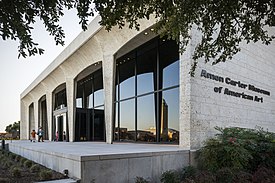
Main archway to the Amon Carter Museum of American Art, constructed 1961. Drinking glass panels and museum entry doors renovated 2015.
Mitchell Wilder died in 1979 afterwards a brief illness. 4 other directors have headed the museum in the years since. They are January Keene Muhlert (1980–95), Dr. Rick Stewart (1995–2005), Dr. Ron Tyler (2006–11), and Dr. Andrew J. Walker (2011–present). Each worked closely with Amon Carter's daughter, Ruth Carter Stevenson (1923–2013), in determining the museum's course. Stevenson had spent the final years of her begetter'south life in conversation with him about his concepts for a museum and the role it should play in Fort Worth borough life.[38] Information technology was this familiarity with his vision, and her extraordinarily high standards, that would bring Stevenson into a leading part in the museum'due south development.
Jan Keene Muhlert oversaw an aggressive acquisitions program that brought works by William Merritt Chase (1849–1916), Thomas Cole (1801–1848), Arthur Dove (1880–1946), Childe Hassam (1859–1935), and David Johnson (1827–1908) into the drove, crowned by the acquisition in 1990 of Pond by Thomas Eakins (1844–1916).[46] The purchase of the Eakins masterpiece required a upper-case letter campaign to raise ten million dollars and drew on every resource available to Muhlert. Dr. Rick Stewart, Muhlert's successor, is a nationally recognized scholar on the work of Frederic Remington and Charles K. Russell. During his tenure as director, Dr. Stewart added major works to the museum'southward drove past Stuart Davis (1892–1964), Marsden Hartley (1877–1943), and John Singer Sargent (1856–1925). Stewart oversaw the challenging, two-twelvemonth closure during which two previous expansions and the museum's concrete plant were demolished. In their place a much larger facility was erected, culminating in a grand reopening in 2001.[47] When Dr. Stewart stepped down as director, he was named the museum's senior curator of western painting and sculpture.
Dr. Ron Tyler returned to the Amon Carter in 2006 as director. (Dr. Tyler began his museum career at the museum from 1969 to 1986.) During his tenure every bit director, the museum presented major exhibitions of the work of Alfred Jacob Miller (1810–1874) and William Ranney (1813–1857), and an important exhibition of African-American fine art from the private collection of Harmon and Harriet Kelley. Paintings by George de Woods Brush (1855–1941) and Charles Sheeler (1883–1965), likewise as a complete, 20-volume ready of Edward Sheriff Curtis' The North American Indian (1907–1930), were added to the museum's permanent collection during Dr. Tyler's administration.[48] Dr. Andrew J. Walker has led the Amon Carter since 2011. Under Dr. Walker's leadership, the ACMAA has hosted major exhibitions of work past George Caleb Bingham (1811–1879), Will Barnet (1911–2012), and the circle of New York modernists led by artist John Graham (1886–1961). He has overseen additions to the permanent collection of works by Robert Seldon Duncanson (1821–1872), Raphaelle Peale (in memory of Ruth Carter Stevenson), and John Singer Sargent (1856–1925), and he initiated major upgrades to the museum'southward digital presence, including the Connecting to Exhibitions digitization project, a ii-twelvemonth initiative that volition allow online admission to many of the museum's previous art exhibitions.[49]
In 1977, on the occasion of the opening of the Philip Johnson-designed expansion, the Amon Carter Museum of Western Art became the Amon Carter Museum. In 2011, on the occasion of the museum's 50th anniversary, the museum was renamed the Amon Carter Museum of American Art.
Building [edit]
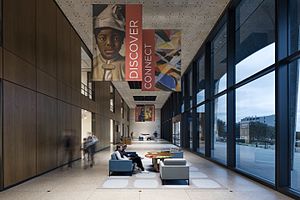
Amon Carter Museum of American Fine art, main entry hall, constructed 1961

Shellstone used to clad the outside of the 1961 edifice and portions of the museum's present-day interior
Builder Philip C. Johnson (1906–2005) maintained a forty-yr clan with the Amon Carter Museum of American Art as the designer of the institution's original edifice and two major expansions. The Amon One thousand. Carter Foundation offset commissioned Johnson in 1958 to devise a museum building that would showcase a cadre collection of western art and also serve as a memorial to the museum'southward founder.[l] At the time Johnson won this commission he was also overseeing construction of the new Munson-Williams-Proctor Arts Institute Museum of Art in Utica, New York.[51] Johnson plant the Carter museum project especially inspiring because of the spectacular view from the proposed museum's edifice site on a gently sloping hillside overlooking downtown Fort Worth.[52] Amon 1000. Carter, Sr. had personally chosen the site in 1951.[35] Johnson placed the museum building every bit far up the hillside every bit possible in society to maximize this panoramic view to the e.[53]
Johnson designed a ii-story portico with five arches that faced east toward the city's skyline. The arches and their tapered support columns were clad in creamy Texas shellstone. The remaining three sides of the 20,000-square-human foot edifice were also covered with shellstone cladding. Sheltered by the arched portico, the museum's front wall consisted of a ii-story curtain of glass windows with bronze mullions.[35] Johnson identified Florence's Loggia dei Lanzi and Munich'south Felderrnhalle every bit precedents for the "boxes with fronts" style portico.[54] The principal entrance atomic number 82 directly into a 2-story hall adorned with the aforementioned type of shellstone used on the exterior, teak wall coverings, and a flooring of pink and gray granite. Beyond the primary hall were five small-scale galleries of equal size for the display of art. On the mezzanine level were five like galleries, each with a balcony that overlooked the main hall. These mezzanine galleries served as library and part spaces.[35] To take advantage of the expanse between the ii-story portico and the site'due south eastern boundary, Johnson designed a series of wide steps and terraces extending away from the building, with an expansive sunken, grassy plaza as the centerpiece, pointing toward the city's middle.[36]
The museum and grounds opened to the public on January 21, 1961, equally the Amon Carter Museum of Western Art. Reaction past critics to Philip Johnson's blueprint was generally favorable. In a March 1961 article, "Portico on a Plaza," the Architectural Forum called it "an exceedingly handsome edifice -- beautifully situated and beautifully illuminated."[55] Russell Lynes, writing in the May 1961 Harper'southward, summed upward his reaction by calling it "Mr. Johnson's gem box."[56]
Although the museum was conceived every bit a pocket-sized memorial establishment, it well-nigh immediately became a collecting museum, and the space afforded past the existing facility quickly became inadequate.[57] In 1964, three years subsequently the museum first opened, a 14,250-square-pes addition was completed on the w side of the original building to provide room for offices, a bookstore, a research library, and an art-storage vault.[35] Joseph R. Pelich (1894–1968) of Fort Worth, an associate architect of the original building, carried out the work afterwards Philip Johnson expressed little interest in taking on the project.[58]
The museum opened a 2d major improver, this 1 designed past Philip Johnson and his partner, John Burgee, in 1977. The 1977 addition, which left the 1961 building and 1964 addition intact, expanded the museum'south surface area by 36,600 foursquare feet, more than doubling its original size.[35] The expansion, which included a 3-story department, enclosed the triangular space at the far western stop of the building site, thus bringing the physical institute to its westernmost limit.[58] Johnson'southward 1977 add-on created an administrative wing, a 105-seat auditorium, a ii-story storage vault, a spacious library, and 2 interior grassed courts that insulated occupants of the library and authoritative offices from heavy traffic passing nearby.
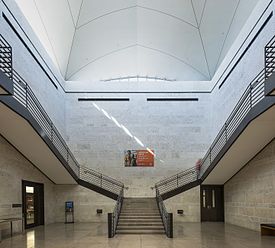
Amon Carter Museum of American Art, central atrium (the Lantern), synthetic 2001
On November 17, 1998, museum trustees announced plans to aggrandize the museum still again. Museum personnel had been in give-and-take with Philip Johnson for some fourth dimension regarding the need to alter Johnson'south 1977 improver.[57] Johnson's solution was to demolish both the 1964 and 1977 additions and create a new, much larger construction behind the 1961 building. Philip Johnson spearheaded the new design in collaboration with his partner Alan Ritchie. It would exist one of the last projects on which Johnson worked.[57] In August 1999 the museum was closed to the public for an extended catamenia while the 1961 building was refurbished, the 1964 and 1977 additions were removed, and the new add-on constructed.
The current museum edifice reopened to the public on October 21, 2001. The 2001 expansion, which increased the museum'south available space by 50,000 square feet, rests on the same footprint as the before additions.[57] It is clad in dark Arabian granite so every bit to recede visually from the lite-colored shellstone of the 1961 building.[57] The expansion's most arresting feature is a centrally located atrium, rising 50-five feet to a higher place the floor and topped past a curved roof with side windows, referred to as the Lantern.[57] The atrium'due south interior walls are clad in the signature shellstone. A double stairway gives access from the atrium to a complex of second-floor galleries where selections from the museum's permanent collection, forth with special exhibitions, are on display.[57] In this new alignment, most of the galleries in the 1961 building, including the mezzanine expanse where the library and offices were once located, are used for rotating exhibitions of paintings and sculpture by Remington and Russell from Amon G. Carter'due south original drove.
Other features of Philip Johnson's 2001 expansion include a 160-seat auditorium, complete with altitude-learning engineering; climate-controlled vaults for both cool and cold photography storage; laboratory space for the conservation of photographs and works on newspaper; a research library and archives storage facility; and a museum bookstore.[59]
In the summer of 2019, the museum building was closed for a renovation of the edifice and the galleries. The Boston-based architecture firm Schwartz/Argent Architects oversaw the renovations; dissimilar the 1977 and 2001 closures, there was little amending to the museum building's structure. Instead, the museum redesigned parts of the interior arranging its collection brandish thematically rather than chronologically. The renovation expanded the brandish expanse by the installation of movable, modular walls. The gallery spaces, which had previously been carpeted, were replaced with American white oak hardwood floors. Following Johnson's original vision for expansive natural lighting, new LED and skylights were installed in the galleries. The installation of an automated shading system enabled the display of artworks in the anteroom. The Texas sculptor James Surls'due south Seven and Seven Flower and Justin Favela's Puente Nuevo were among the first large scale artworks displayed in the downstairs hallway connecting the 1961 edifice with the 2001 expansion every bit function of the redesign.
The 2019 renovations received positive feedback from the local press. James Russell praised the redesigned galleries in the Fort Worth Weekly, noting that they created "an temper for exploration."[60] Dallas Morning News compages critic, Marker Lamster lamented that the redesign upended the original design'southward " juxtaposition of the grand formal entry with . . . those more intimate galleries," but overall considered the renovated galleries "a large comeback."[61]
In add-on to the redesigned galleries, the photography cold storage vaults were renovated to accommodate the growing and collection and to provide updated preservation technologies.[62] Fort Worth philanthropist Ed Bass helped to fund a Gentling Study Center located in the Museum Library dedicated to the artwork of Fort Worth brothers, Stuart Due west. and Scott G. Gentling. The creation of the Gentling Study Center complements the Amon Carter Museum'southward planned exhibitions and publications on the Gentling brothers.[63] The Report Center's interior design mirrors the teak wall coverings and mid-century piece of furniture that narrate Johnson's original design. Compages critic, Mark Lamster singled out the Gentling Library for its "pleasingly midcentury gestalt."[61]
More American art from the collection [edit]
-
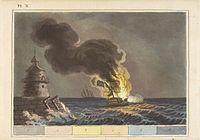
Plate x from The art of colouring and painting landscapes in water colours, Baltimore: Fielding Lucas, 1815
-
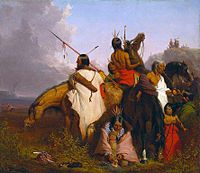
Charles Deas (1818–1867), Indian Group, 1845
-
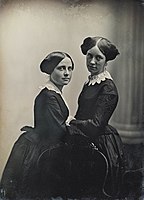
Albert Sands Southworth (1811–1894) and Josiah Hawes (1818–1901), [Two women posed with a chair], ca. 1850
-

William Sharp (1803–1875), Victoria Regia - Intermediate Stages of Bloom, 1854
-

Heinrich Möllhausen (1825–1905), Canadian River Virtually Camp 38, 1855
-
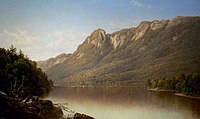
David Johnson (1827–1908), Hawkeye Cliff, Franconia Notch, New Hampshire, 1864
-

Martin Johnson Heade (1818–1904), Marshfield Meadows, Massachusetts, 1866–76
-
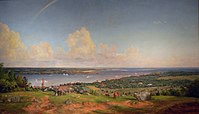
Jasper Francis Cropsey (1823–1900), The Narrows from Staten Island, 1868
-

Robert Seldon Duncanson (1821–1872), The Caves, 1869
-

George Caleb Bingham (1811–1879), View of Freeway's Peak, 1872
-

Thomas Moran (1837–1926), Cliffs of Green River, 1874
-
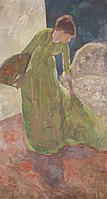
Mary Cassatt (1844–1926), Woman Standing, Holding a Fan, 1878–79
-

Thomas Eakins (1844–1916), Swimming, 1885
-

Dennis Miller Bunker (1861–1890), In the Greenhouse, 1888
-

John Vocalizer Sargent (1856–1925), Alice Vanderbilt Shepard, 1888
-

John Singer Sargent (1856–1925), Edwin Booth, 1890
-

Frederic Remington (1861–1909), A Dash for the Timber, 1889
-

Frederic Remington (1861–1909), His First Lesson, 1903
-

Charles Thousand. Russell (1864–1926), In Without Knocking, 1909
-

Erwin Due east. Smith (1886–1947), A wrangler keeping an eye on the remuda grazing below in an arroyo, 1910
-
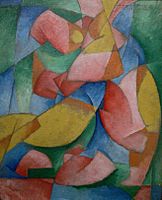
Morton Livingston Schamberg (1881–1918), Effigy, 1913
-

Gaston Lachaise (1882–1935), Adult female Seated, modeled 1918, bandage 1925
-

Charles Sheeler (1883–1965), Conversation - Heaven and Earth, 1940
-

Louise Nevelson (1899–1988), Lunar Landscape, 1959–lx
Run into also [edit]
- American Art Collaborative
- List of museums in North Texas
References [edit]
- ^ Amon Carter Museum: About, ARTINFO, 2008, archived from the original on 2009-01-13, retrieved 2008-07-28
- ^ a b Roark, Carol; et al. (1993). Catalogue of the Amon Carter Museum Photography Collection. Fort Worth, Texas: Amon Carter Museum. pp. Introduction xi. ISBN0-88360-063-3.
- ^ a b Stewart, Rick (2001). The Thousand Borderland: Remington and Russell in the Amon Carter Museum. Fort Worth: Amon Carter Museum. p. three. ISBN0-88360-095-1.
- ^ Junker, Patricia; et al. (2001). An American Collection: Works from the Amon Carter Museum. New York: Hudson Hills Press in association with the Amon Carter Museum. pp. 12–14. ISBN1-55595-198-8.
- ^ Shaw, Punch (14 October 2001). "Wonders of the Western World: The Masterworks of Remington and Russell volition now be more visible than ever". archive. Fort Worth Star-Telegram. pp. 3D. Retrieved thirty May 2016.
- ^ Dippie, Brian (1982). Remington and Russell: The Sid Richardson Collection. Austin, Texas: University of Texas Press Austin. p. nine. ISBN0-292-77027-8.
- ^ Dippie, Brian (1982). Remington and Russell: The Sid Richardson Drove. Austin, Texas: Academy of Texas Press Austin. p. 12. ISBN0-292-77027-viii.
- ^ Dippie, Brian (1982). Remington and Russell: The Sid Richardson Collection. Austin, Texas: University of Texas Press Austin. p. 11. ISBN0-292-77027-8.
- ^ Dippie, Brian (1982). Remington and Russell:The Sid Richardson Collection. Austin, Texas: University of Texas Press Austin. pp. 8–9. ISBN0-292-77027-8.
- ^ Stewart, Rick (2005). The Grand Borderland. Fort Worth: Amon Carter Museum. pp. 8–9. ISBN0-88360-098-6.
- ^ Stewart, Rick (2005). The Grand Borderland. Fort Worth: Amon Carter Museum. p. 19. ISBN0-88360-098-half dozen.
- ^ Stewart, Rick (2005). The Grand Borderland. Fort Worth: Amon Carter Museum. p. 42. ISBN0-88360-098-6.
- ^ Stewart, Rick (1994). "Charles M. Russell:Sculptor". Fort Worth: Amon Carter Museum. pp. 286–290.
- ^ Ayres, Linda; et al. (1986). American Paintings: Selections from the Amon Carter Museum. Birmingham, AL: Oxmoor House. pp. seven–x. ISBN0-8487-0694-3.
- ^ Ayres, Linda; et al. (1986). American Paintings: Selections from the Amon Carter Museum. Birmingham, AL: Oxmoor House. p. 10. ISBN0-8487-0694-iii.
- ^ Ayres, Linda; et al. (1986). American Paintings: Selections from the Amon Carter Museum. Birmingham, AL: Oxmoor House. p. 20. ISBN0-8487-0694-3.
- ^ Bolger, Doreen, ed. (1996). Thomas Eakins and the Swimming Picture. Fort Worth: Amon Carter Museum. pp. Introduction vii. ISBN0-88360-085-4.
- ^ Junker, Patricia; et al. (2001). An American Collection: Works from the Amon Carter Museum. New York: Hudson Hills Press in association with the Amon Carter Museum. pp. 112–113. ISBN1-55595-198-8.
- ^ Junker, Patricia; et al. (2001). An American Collection: Works from the Amon Carter Museum. New York: Hudson Hills Press in association with the Amon Carter Museum. pp. 96–97. ISBN1-55595-198-8.
- ^ Junker, Patricia; et al. (2001). An American Collection: Works from the Amon Carter Museum. New York: Hudson Hills Printing in association with the Amon Carter Museum. pp. 116–117. ISBN1-55595-198-8.
- ^ Junker, Patricia; et al. (2001). An American Drove: Works from the Amon Carter Museum. New York: Hudson Hills Press in association with the Amon Carter Museum. p. 220. ISBNi-55595-198-eight.
- ^ Junker, Patricia; et al. (2001). An American Collection: Works from the Amon Carter Museum. New York: Hudson Hills Press in Clan with the Amon Carter Museum. p. 15. ISBN1-55595-198-8.
- ^ Myers, Jane (2011). The Allure of Newspaper: Watercolors and Drawings from the Amon Carter Museum of American Art. Fort Worth: Amon Carter Museum of American Fine art. p. 9. ISBN978-1-4507-6353-0.
- ^ a b Myers, Jane (2011). The Allure of Paper: Watercolors and Drawings from the Amon Carter Museum of American Art. Fort Worth: Amon Carter Museum of American Art. p. x. ISBN978-1-4507-6353-0.
- ^ "Works on Paper Amon Carter Museum". Amon Carter Museum of American Art. 2006-09-21. Retrieved 29 May 2016.
- ^ Myers, Jane (2011). The Attraction of Paper: Watercolors and Drawings from the Amon Carter Museum of American Art. Fort Worth: Amon Carter Museum of American Art. p. 11. ISBN978-1-4507-6353-0.
- ^ a b c d "Library Collections". Amon Carter Museum of American Art. 2009-03-12. Retrieved 29 May 2016.
- ^ "Archives of American Art". Smithsonian Institution. Retrieved 29 May 2016.
- ^ "ACMAA Illustrated Books". Amon Carter Museum of American Fine art. 2011-06-08. Retrieved 29 May 2016.
- ^ "Museum Archives". Amon Carter Museum of American Fine art. 2009-03-12. Retrieved 29 May 2016.
- ^ "CDLC Bones Search". Texas Christian University library. Retrieved 29 May 2016.
- ^ "Amon G Carter Foundation". Amon K Carter Foundation. Retrieved 2 June 2016.
- ^ Junker, Patricia; et al. (2001). An American Collection: Works from the Amon Carter Museum. New York: Hudson Hills Press in association with the Amon Carter Museum. p. eleven. ISBNi-55595-198-viii.
- ^ Junker, Patricia; et al. (2001). An American Collection: Works from the Amon Carter Museum. New York: Hudson Hills Printing in association with the Amon Carter Museum. p. 13. ISBN1-55595-198-eight.
- ^ a b c d e f Martin, Carter (1996). 150 Years of American Art: Amon Carter Museum Collection. Fort Worth: Amon Carter Museum. pp. five. ISBN0-88360-087-0.
- ^ a b Junker, Patricia; et al. (2001). An American Drove: Works from the Amon Carter Museum. New York: Hudson Hill Press in clan with the Amon Carter Museum. p. 14. ISBNane-55595-198-viii.
- ^ Wright, George (1997). Monument for a City: Philip Johnson's Design for the Amon Carter Museum. Amon Carter Museum. p. 25. ISBN0-88360-088-9.
- ^ a b Martin, Carter (1996). 150 Years of American Art: Amon Carter Museum Collection. Fort Worth: Amon Carter Museum. pp. 3. ISBN0-88360-087-0.
- ^ "Metropolis Council Approves Art Museum Contract". Fort Worth Star-Telegram. 28 February 1959. pp. 1 and six. Retrieved two June 2016.
- ^ "Museum Dedicated, Will Open Tuesday". Fort Worth Star-Telegram. 23 January 1961. p. 1. Retrieved 2 June 2016.
- ^ "Two Leaders Bring together Art Community". Fort Worth Star-Telegram. 6 August 1961. pp. Section iii pp. 14. Retrieved 2 June 2016.
- ^ a b Ayres, Linda; et al. (1986). American Paintings: Selections from the Amon Carter Museum. Birmingham, Alabama: Oxmoor House. pp. Intro. vii. ISBN0-8487-0694-three.
- ^ "Amon Carter Museum of American Fine art: Institutional Timeline" (PDF). Amon Carter Museum of American Art. p. 3. Archived from the original (PDF) on 24 June 2016. Retrieved ii June 2016.
- ^ "Amon Carter Museum of American Art: Institutional Timeline" (PDF). Amon Carter Museum of American Art. p. 4. Archived from the original (PDF) on 24 June 2016. Retrieved 2 June 2016.
- ^ "Amon Carter Museum of American Art: Institutional Timeline" (PDF). Amon Carter Museum of American Art. p. 5. Archived from the original (PDF) on 24 June 2016. Retrieved 2 June 2016.
- ^ "Amon Carter Museum of American Art: Institutional Timeline" (PDF). Amon Carter Museum of American Fine art. pp. 9–12. Archived from the original (PDF) on 24 June 2016. Retrieved 2 June 2016.
- ^ "Amon Carter Museum of American Art: Institutional Timeline" (PDF). Amon Carter Museum of American Fine art. pp. 13–15. Archived from the original (PDF) on 24 June 2016. Retrieved two June 2016.
- ^ "Welcome to the Amon Carter Press Room". Amon Carter Museum of American Fine art. pp. 4–6. Retrieved two June 2016.
- ^ "Welcome to the Amon Carter Press Room". Amon Carter Museum of American Fine art. pp. 1–iii. Retrieved 2 June 2016.
- ^ Murray, Mary; et al. (2010). Look for Beauty: Philip Johnson and Fine art Museum Design. Utica, New York: Munson-Williams-Proctor Arts Found. p. 29. ISBN978-0-915895-37-3.
- ^ Murray, Mary; et al. (2010). Look for Beauty: Philip Johnson and Fine art Museum Design. Utica, New York: Munson-Williams-Proctor Arts Institute. pp. 7–16. ISBN978-0-915895-37-3.
- ^ Wright, George (1997). Monument for a City: Philip Johnson's Design for the Amon Carter Museum. Fort Worth: Amon Carter Museum. p. five. ISBN0-88360-088-ix.
- ^ Wright, George (1997). Monument for a City: Philip Johnson's Design for the Amon Carter Museum. Fort Worth: Amon Carter Museum. p. eight. ISBN0-88360-088-9.
- ^ Moorhead, Gerald (2019). Buildings of Texas: East, North Central, Panhandle and Due south Plains, and West. Charlottesville and London: University of Virginia Press. p. 214. ISBN9780813942346.
- ^ "Portico on a Plaza". Architectural Forum. March 1961.
- ^ "Everything's Upwards to Appointment in Texas...But Me". Harper'southward. May 1961.
- ^ a b c d e f g Murray, Mary; et al. (2010). Await for Dazzler: Philip Johnson and Art Museum Design. Utica, New York: Munson-Williams-Proctor Arts Found. p. 33. ISBN978-0-915895-37-iii.
- ^ a b Wright, George (1997). Monument for a Metropolis: Philip Johnson'south Blueprint for the Amon Carter Museum. Fort Worth: Amon Carter Museum. p. 16. ISBN0-88360-088-9.
- ^ Junker Patricia; et al. (2001). An American Collection: Works from the Amon Carter Museum. New York: Hudson Hills Press in association with the Amon Carter Museum. p. 18. ISBN1-55595-198-8.
- ^ Russell, James (September 11, 2019). "Amon Carter'due south Facelift". Fort Worth Weekly . Retrieved November 21, 2019.
- ^ a b "Fort Worth'south Amon Carter museum gets a face-lift, an architecture critic and art critic respond". Dallas Morning time News. October 10, 2019. Retrieved November 21, 2019.
- ^ "Photography Preservation Campaign". Amon Carter Museum of Art: Photography Preservation Entrada. 2017.
- ^ "Amon Carter Museum of American Art Establishes Gentling Study Center". Amon Carter Museum of American Art. August 7, 2019. Retrieved November 21, 2019.
External links [edit]
Coordinates: 32°44′53″North 97°22′08″Westward / 32.748°N 97.369°W / 32.748; -97.369
Source: https://en.wikipedia.org/wiki/Amon_Carter_Museum_of_American_Art
0 Response to "Museum of Fine Arts Amon Carter Museum of American Art"
Post a Comment